Many bloggers are seeking to profit from their time and work, and even hope to see full-time income potential in doing what they love to do: write. But one of the things that so easily slips past the hopeful blogger is that blogging, like any other job, requires a steady amount of work and input. More than that, it requires the same amount of time, and often more, as a regular paying job. This may sound like discouragement to those of you who may seek instant gratification from your writing, but it is - my friends, the truth.
When working a traditional job, the formula is standard and basic: Your time doing their work in exchange for prearranged regular pay. A person generally depends on that formula to live. They are working because their lives depend on that "time + work = money" formula. The employers are typically not paying people to watch television, hang out in the kitchen in their pajamas, chat with friends on Facebook, or plant trees in FarmVille. This is pretty much true of blogging, too. You should be, as you would in any traditional "time + work = money" job, using the majority of the work day doing research, writing, promoting, analyzing, or otherwise building your audience and your blog.
If you are doing any of this in only small amounts, or part of the time, you can probably expect that your blogging income will be slight, as well. Unless you've really latched onto a brilliant and nearly untouched niche subject that people have been dying for information about, you're blog will probably not flourish on its own. You will need to work on it continuously... More specifically, you should be blogging as if your life depends on it. Your blog, like anything else in life, will yield the rewards of the efforts you put forth. Your time plus your hard work will produce an income. How much you earn will be a direct result of how hard (or even how long) you work.
Stick to the formula, whether you seek traditional employment or work on your own.
Time + Work = Money

Blogging from a writer's perspective - a writer's blog about blogging. Tips and advice for better blogging, increasing blog traffic, content writing, and create more useful content for readers. And, how to monetize your blog and how to make money blogging.
Showing posts with label Tips for New Blogs. Show all posts
Showing posts with label Tips for New Blogs. Show all posts
Friday, July 13, 2012


Monday, October 17, 2011
Blogging Quick Tip: Keep Your Blog Audience Interested
What do you see for your blog? Sometimes we get so caught up in searching for the next best marketing tool, and forget all about the tried and true. Sure there are brand new marketing techniques that boost traffic and put your name out there, but it's ultimately up to you to create a buzz and generate hype. Traffic spikes may not do you any good unless you've got a great blog going, or are giving out some awesome information. But some blogs need some old school help, and using some of techniques of old really come in handy. You are your ultimate buziness card, and your blog is your product.
Let's take a moment to examine a common blogging blogging mistake:
This might work if you're Yaro Starak, but not if you're just starting out. It sounds good in theory, and if you are a very established, highly respected blogger it just might keep people coming in, but even Yaro gives out plenty of brilliant marketing techniques, blogging tips, traffic building methods, and ideas that can help any blogger rise above ground level. Even if you have already exposed some of your best information, you can still use that as your selling point for your blog, highlighting your best work by frequently referring and linking to it from other posts or pages, including from your sidebar links.
Attempting to use mystery and enticement to draw in your visitors, and never revealing your true secrets will keep visitors coming, and keep them interested, as long as you give them enough to keep them hooked.
Sunday, May 30, 2010
How to Add Pictures Using Blogger
Using pictures is a great way to keep readers visually stimulated and interested in your blog. You can emphasize a point with a few visual aids, post some artistic imagery, use pictures to sell your products, or just practice your skills in photography and post them here in blogger. So, here's a quick and easy way to add pictures to your blog posts. If you're using blogger, but haven't uploaded pictures to your posts yet, here's a quick and easy tutorial to get you started.
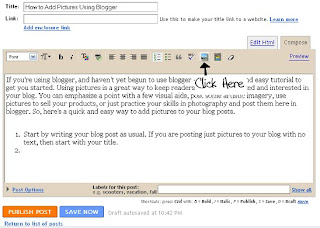
Start by writing your blog post as usual. If you are posting just pictures to your blog with no text, then start with your title.Click the "Add Image" button on the Blogger toolbar, which is located above the posting area, but below the title area. Clicking this will open a pop-up window, so if your browser prevents it, change the settings to allow pop-ups for Blogger.
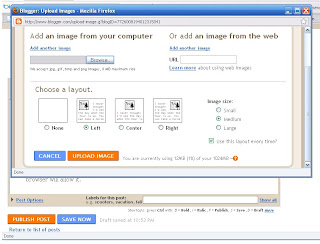
From the pop-up window (shown below) . To search for and upload an image from your computer, select the "Browse" button at the top-left side of the window.
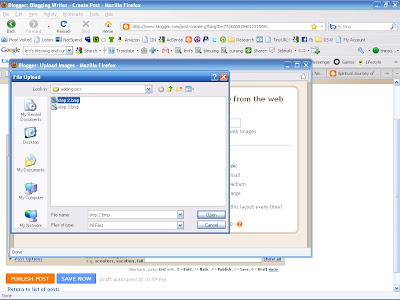
By clicking "Browse", a file search window will open, where you will select the image you wish to use for your blog entry, (shown below). Once you have selected the image, click "Open" and return to the Blogger pop-up.
From the Blogger pop-up, select the size and layout of the image you are uploading. For this tutorial, I have selected the "Center" layout with "Large" images. Click "Upload" and your image will be uploaded to the "Edit Post" screen, although you may need to close the pop-up after the image has finished uploading by simply clicking the red "X" in the top-right corner of the pop-up. From within the "Compose" mode of the "Edit Post" screen, you will see that your photo will automatically default to the top of your post, but you can drag and drop the picture another area within the post if desired.
Here are some more examples of layout positions, using "Small" sized images:
 This image was placed using the "None" layout option. Notice how the bottom of the first line of text is lined up with the bottom of the image, and continues from there in the form of a paragraph. If you have selected this position on accident, you can either select the image by clicking on it, then delete it, or use the "Edit Html" to change the position within the HTML code, (caution: recommended only for somewhat experienced HTML users).
 This image was placed using the "Left" layout option. Notice that the image is located at the left, within the body of the paragraph. This option creates a nice clean layout. Your text will wrap around the bottom of the text as you continue to type your blog post.
 The next picture is located to the right of the text, using the "Right" layout option. The picture is neatly situation within the body of the paragraph, as it is with the "Left" layout option. Additional text within the paragraph that extends beyond the borders of the picture or image will wrap around it, creating a clean and neat layout for your blog post. As you can see by the positioning of the "Left" and "Right" examples, you can easily use the two layout options to align pictures to both the left and right. You can also use the alignment buttons at the top of the editing area in "Compose" mode to align your text to fit your needs.
So now you can actively create eye-catching blog posts that captivate your readers, both visually - as well as with the well-written blog content they originally came to read! Have fun with your posts, but remember not to violate any copyrights by using pictures that you didn't take, or images you didn't create. Always obtain permission, or obtain some of the many royalty-free stock photos and images available on the web.
Start by writing your blog post as usual. If you are posting just pictures to your blog with no text, then start with your title.Click the "Add Image" button on the Blogger toolbar, which is located above the posting area, but below the title area. Clicking this will open a pop-up window, so if your browser prevents it, change the settings to allow pop-ups for Blogger.

From the pop-up window (shown below) . To search for and upload an image from your computer, select the "Browse" button at the top-left side of the window.

By clicking "Browse", a file search window will open, where you will select the image you wish to use for your blog entry, (shown below). Once you have selected the image, click "Open" and return to the Blogger pop-up.

From the Blogger pop-up, select the size and layout of the image you are uploading. For this tutorial, I have selected the "Center" layout with "Large" images. Click "Upload" and your image will be uploaded to the "Edit Post" screen, although you may need to close the pop-up after the image has finished uploading by simply clicking the red "X" in the top-right corner of the pop-up. From within the "Compose" mode of the "Edit Post" screen, you will see that your photo will automatically default to the top of your post, but you can drag and drop the picture another area within the post if desired.
Here are some more examples of layout positions, using "Small" sized images:
 This image was placed using the "None" layout option. Notice how the bottom of the first line of text is lined up with the bottom of the image, and continues from there in the form of a paragraph. If you have selected this position on accident, you can either select the image by clicking on it, then delete it, or use the "Edit Html" to change the position within the HTML code, (caution: recommended only for somewhat experienced HTML users).
 This image was placed using the "Left" layout option. Notice that the image is located at the left, within the body of the paragraph. This option creates a nice clean layout. Your text will wrap around the bottom of the text as you continue to type your blog post.
 The next picture is located to the right of the text, using the "Right" layout option. The picture is neatly situation within the body of the paragraph, as it is with the "Left" layout option. Additional text within the paragraph that extends beyond the borders of the picture or image will wrap around it, creating a clean and neat layout for your blog post. As you can see by the positioning of the "Left" and "Right" examples, you can easily use the two layout options to align pictures to both the left and right. You can also use the alignment buttons at the top of the editing area in "Compose" mode to align your text to fit your needs.
So now you can actively create eye-catching blog posts that captivate your readers, both visually - as well as with the well-written blog content they originally came to read! Have fun with your posts, but remember not to violate any copyrights by using pictures that you didn't take, or images you didn't create. Always obtain permission, or obtain some of the many royalty-free stock photos and images available on the web.
Wednesday, April 1, 2009
How to Write an Article You Can Sell
Selling an article can be a little tough if you're relatively new to the field of paid writing. Starting with a layout that works for most of your articles can save you time and energy, and increase your productivity throughout the day.
Popular Article Types
Depending on the criteria of the particular articles you write, and where they will appear, you may find that you are asked to write articles that fall in to the following categories: About, How To, What Is, Facts, How it Works, or Lists of information and sources.
Structure
Develop a precise method to writing each type of article you will be selling, and even create a template that you can use each time, with defined areas for information. Use the structure that you create - each and every time you write that type of article. This is where most of your time will be spent.
Forward Moving Text
Write each paragraph so that it leads into the next paragraph. Avoid stringing your reader along in hopes of keeping them interested. The readers' time is valuable, and they want to get straight to the point. Since most people "skim" the page, looking for useful information, be sure to highlight each section with a relevant heading.
Research
Use several resources to verify the information you are presenting in your articles. Take notes using pencil and paper, rather than with a word processor, which will help you to avoid the temptation to "copy and paste" someone else's work. Your research is to help back up the information in your article only, not where you should get your words.
Resources
Provide resources that provide additional reading that may be of interest to your readers, or that further explain the process or information in your article. Use citations and quotes minimally, providing resources whenever possible.
Rewriting and Renewing
Read through some of the articles you may have in your archives. You may find that by using your newly created structure, you are able you write new articles based on research you used in previous articles. Writing articles that are similar, but cover a different aspect of a subject can be a great way of saving time on research, and provide some additional resources for rewrites, or updating old articles with newly researched facts.
Using Structure Over Time
Using a structured method will help you to develop a pattern to your writing, and eventually a style that defines you, no matter what the subject matter is. Your interest in certain details when researching will influence the direction your articles take, and a predetermined structure will help you stick to the topic throughout your article.
Popular Article Types
Depending on the criteria of the particular articles you write, and where they will appear, you may find that you are asked to write articles that fall in to the following categories: About, How To, What Is, Facts, How it Works, or Lists of information and sources.
Structure
Develop a precise method to writing each type of article you will be selling, and even create a template that you can use each time, with defined areas for information. Use the structure that you create - each and every time you write that type of article. This is where most of your time will be spent.
Forward Moving Text
Write each paragraph so that it leads into the next paragraph. Avoid stringing your reader along in hopes of keeping them interested. The readers' time is valuable, and they want to get straight to the point. Since most people "skim" the page, looking for useful information, be sure to highlight each section with a relevant heading.
Research
Use several resources to verify the information you are presenting in your articles. Take notes using pencil and paper, rather than with a word processor, which will help you to avoid the temptation to "copy and paste" someone else's work. Your research is to help back up the information in your article only, not where you should get your words.
Resources
Provide resources that provide additional reading that may be of interest to your readers, or that further explain the process or information in your article. Use citations and quotes minimally, providing resources whenever possible.
Rewriting and Renewing
Read through some of the articles you may have in your archives. You may find that by using your newly created structure, you are able you write new articles based on research you used in previous articles. Writing articles that are similar, but cover a different aspect of a subject can be a great way of saving time on research, and provide some additional resources for rewrites, or updating old articles with newly researched facts.
Using Structure Over Time
Using a structured method will help you to develop a pattern to your writing, and eventually a style that defines you, no matter what the subject matter is. Your interest in certain details when researching will influence the direction your articles take, and a predetermined structure will help you stick to the topic throughout your article.
Friday, February 27, 2009
Blog Tip: The Flavor Comes Out When You Stir Up the Pot
Don't Be a Blogging 'Yes Man'
Being polite and agreeable has its place, but it's not in the blogging world. While there are a plethora of eager-to-please bloggers out there circulating their sheeple shit, very few bloggers are willing to share their true opinions. Too many bloggers forget that not only do we have a voice, but with the right words - we have the ability to communicate with millions. The ability to seek truth and relay facts on an international level within minutes from the homes of billions around the world is fantastic - and yet it a completely accessible communication medium to anyone with a voice and a computer with internet.
Media bloggers pumping regurgitated news blurbs on all the major networks fail to present the burning questions of our time, let alone finding answers. The internet has turned many people into truth seekers and instant researchers, obtaining answers in just a few clicks. Some argue that bloggers are the journalists of our future; others believe that bloggers are nothing more than idiots with web access and a meaningless opinion.
The fact of the matter is, bloggers have become part of a pivotal point in our social society, as well as a major contributor to the continued success of many online businesses. Bloggers are being noticed as having the ability to create hype and fame, as well as destroy lives and spread rumors that reach millions in the blink of an eye.
So what really makes bloggers and journalists different? While many journalists pride themselves on their education and their degree, believing that their credentials cause ears to listen - their degree and reputation cause them to repress many of the truths that they once sought to expose. Bloggers, on the other hand, display a fearlessness unlike that of traditional journalists. They often have no reputation to destroy, but are often discovered based on their controversial views - and the courage to share them openly.
Don't be afraid to stir up the pot; throw in a little controversy to mix it up a little. Have the courage to share the facts you find with others. Be confident enough in your research to contradicts the mainstream media coverage of a story, or the details of hidden facts kept from breaking stories on the news. Go ahead, YOU break the story!
Being polite and agreeable has its place, but it's not in the blogging world. While there are a plethora of eager-to-please bloggers out there circulating their sheeple shit, very few bloggers are willing to share their true opinions. Too many bloggers forget that not only do we have a voice, but with the right words - we have the ability to communicate with millions. The ability to seek truth and relay facts on an international level within minutes from the homes of billions around the world is fantastic - and yet it a completely accessible communication medium to anyone with a voice and a computer with internet.

Media bloggers pumping regurgitated news blurbs on all the major networks fail to present the burning questions of our time, let alone finding answers. The internet has turned many people into truth seekers and instant researchers, obtaining answers in just a few clicks. Some argue that bloggers are the journalists of our future; others believe that bloggers are nothing more than idiots with web access and a meaningless opinion.
The fact of the matter is, bloggers have become part of a pivotal point in our social society, as well as a major contributor to the continued success of many online businesses. Bloggers are being noticed as having the ability to create hype and fame, as well as destroy lives and spread rumors that reach millions in the blink of an eye.
So what really makes bloggers and journalists different? While many journalists pride themselves on their education and their degree, believing that their credentials cause ears to listen - their degree and reputation cause them to repress many of the truths that they once sought to expose. Bloggers, on the other hand, display a fearlessness unlike that of traditional journalists. They often have no reputation to destroy, but are often discovered based on their controversial views - and the courage to share them openly.
Don't be afraid to stir up the pot; throw in a little controversy to mix it up a little. Have the courage to share the facts you find with others. Be confident enough in your research to contradicts the mainstream media coverage of a story, or the details of hidden facts kept from breaking stories on the news. Go ahead, YOU break the story!
Tuesday, December 16, 2008
Blogging Labeled as Dangerous, But is it Really True?
 Within the past few years, bloggers have proven that it is entirely possible to make a decent living through blogging. Many people make a good income doing it, and for a select group of blogging elites, the has even brought them fame and fortune. But for at least a few bloggers, their intense drive to be the first to blog about breaking industry news may have led to their deaths.
While the simplicity of blogging for financial gain has drawn an incredible number of aspiring bloggers to dump the contents of their minds into the blogosphere at an alarming rate, it has also created the myth that anyone can be a successful blogger. But with any amount of experience as a serious blogger, one quickly realizes that spitting out regurgitated news just simply isn't good enough. Hence, the bad wrap - that blogging is dangerous to your health.
The notion that blogging could be deadly certainly is plausible in extreme cases, as many of the most successful bloggers rarely sleep, drink meals in the form of protein-caffeine cocktails, and spend nearly every waking hour in a highly competitive news breaking frenzy with global competitors. But the suggestion that blogging could bring about the levels of stress that are experienced by commercial airline pilots, or that the amount of danger that a blogger faces on the job is comparable to that of a coal miner is a giant leap over the edge of truth.
The reality of it is, blogging is what you make of it. It probably isn't fair to say that blogging in general is very competitive, because the truth of it is, a huge population of bloggers write because they enjoy it. It is considered by many to be an emotional outlet of sorts; a place of self-satisfaction, a release of words begging to come out and speak to someone . . . anyone . . . or even no one at all.
The dangers of blogging in general aren't necessarily higher than those of other computer based desk jobs. Sometimes, in order to be successful at something, you've got to put your all into your goal. To be honest, the success that some bloggers have achieved - generally comes with a high level of stress.
 But don't let yourself be fooled into thinking that you would be a great blogger because you love the computer and hate getting out of bed in the morning, it takes time and a lot of hard work to build a thriving blog and an established readership. And as with anything else you may do for a living, you've gotta love it. In fact, just loving blogging isn't always enough. Darren Rowse of ProBlogger once said that he had to blog as if his life depended on it - because it did. He has since become known as a pioneer in the blogging industry, and has achieved a great level of success and respect in the blogging industry.
Wednesday, November 12, 2008
The Truth About Blogging and Adsense
 Warning: If you are overly sensitive to the truth, you may not continue to read this blatant post!
When I attended career guidance classes in high-school, I don't quite remember "sitting around in my underwear checking my AdSense stats" being on the list of possible careers, but it seems to be quite the dream job of today. While there are a few of us who like to keep busy, I'm pretty sure there are millions of people out there who would just love to quit working and take a permanent all-expenses paid vacation. But that's just not reality, no matter how great it sounds.
Bloggers Needed: Lazy People Need Not Apply
First of all, successful blogging is work. I'm not sure how much of that is making sense, but the keyword here is: WORK. I do agree, it's not always hard work, but it is work nonetheless. The sooner you believe and understand the fact that blogging requires work, the sooner you can begin to enjoy your job. If that was not too difficult for you to swallow, you may want to continue reading about what AdSense can do for you.
If you already have a high level of traffic, AdSense has a tendency to produce two more common results: Based on a high percentage of "clickers", you may actually start off day one earning Adsense revenue. On the flip side, if you have a lot of loyal readers who enjoy the fact that your blog remains ad-free, you run the risk of offending them. Many readers enjoy non-threatening environment of a blog that isn't trying to sell them anything, including "junk-advertising".
The AdSense Catch-22
If your site has relatively few readers or visitors, you won't necessarily offend anyone - but you probably won't make any money the first day, either. As your readers develop a loyalty to you as a writer, they will have already been exposed to your AdSense ads, and still continue to frequent your blog. As your readership grows, depending on your niche - your earnings should correspondingly increase. But this is not always true. Some niches simply produce more "clicking" visitors than others. In fact, if your niche is not product based, you may find that the relevant ads are actually not relevant at all, and may not generate interest or clicks.
By implementing your ads in higher visibility areas, you will increase the visibility of the ads, encouraging more clicks, but you also compromise your layout design, and should be careful not to give up valuable "real-estate" on your blog to irrelevant material. Be sure to place some of your most useful information in neighboring spaces, so that you ensure that your readers will not only be exposed to your ads, but have an equal opportunity to read the information they came to read. If your ads are more prominent than your content, you may find that your visitors quickly leave your site through your ads. If you simply to wish to generate clicks, I suppose this would be the way to go, but most bloggers are genuinely interested in having their content actually read! In that case, concentrate on your content - and its visibility.
Ignore your readers - and they'll go away.
Personally, I am more motivated by returning visitors, multiple page views, and lengthy visits than how many pennies I can earn per visitor. But by the same token, I am also encouraged by the possibility that I may not provide everything my readers want, and that perhaps through relevant ads, I might give them something they are looking for - while earning revenue at the same time.
When properly balanced, AdSense can be a valuable tool for both readers and bloggers, providing additional content and products to your visitors, and generating revenue for bloggers and website owners, without interrupting the blog-reading experience for the visitors.
Monday, April 14, 2008
Dispelling Myths about Blog Post Frequency
Sorting through all the "post frequency" garbage on the web can be a little confusing, and sometimes discouraging. But knowing how often to post on your blog could give you an edge over your competition, even if you are posting less frequently than they are. While frequent posts and mass content may have helped boost traffic and search engine visibility in the early days of blogging, web-clutter is piling up fast, and making it more difficult to find valuable sources of information on the net.
MYTH: Frequent posting will increase blog traffic and RSS subscriptions.
TRUTH: Regularly appearing posts can make it easier for readers to know how often to check your blog for new content. It also allows search engines to determine how often to crawl your site. But with an increasingly high number of readers turning to RSS feeds, too many posts bombard your subscribers, causing even loyal readers to unsubscribe!
MYTH: Daily posts are what readers want.
TRUTH: Readers want to spend their time reading quality content, juicy tid-bits, useful information, or something that specifically sparks their interest. Most successful bloggers agree that the usefulness or value of the post is much more important than the frequency. Too many new bloggers quit after just a few months, or sooner. All of these brief little posts are accumulating in the blogosphere - creating a veritable blogging landfill within the search engines. Cut down on the clutter that is clogging up the lines of communication. I'm not implying that we lobby for a virtual-green blogging ecosystem - just suggesting we all use a bit of common sense.
MYTH: Short frequent posts are better than long articles posted less frequently.
TRUTH: Unless you can string together a handful of words to brilliantly convey your point, providing your audience with something of value in just a few sentences, you may do well to avoid short frequent posting. Remember what grandma used to say - if you don't have anything nice to say . . ? Well let's put a web 2.0 spin on that old saying:
"If you don't have anything useful or valuable to post - don't post anything at all."
Restrain Yourself!
Frequent posting is (in part) what fuels low-quality posts. As a blogger, you could very well downgrade the quality of your entire blog if you allow the pressure of frequent posting get to you. It is best to take a fair amount of time researching your information and providing useful and valuable information to your readers.
How often you post is of less importance than the quality of your posts. If you have something valuable and useful to say - post it, regardless of how often you post. Articles and posts that are timeless (meaning they will still be valuable next week - or next year) will continue to draw attention long after they have been posted. Posting too frequently could bury some of your more useful posts in your archives, and new visitors may never take the time to find the value in your blog. But when each and every post adds more value to your blog, it invites multiple page views, repeat visits, and loyal readers who eagerly await your next post.

MYTH: Frequent posting will increase blog traffic and RSS subscriptions.
TRUTH: Regularly appearing posts can make it easier for readers to know how often to check your blog for new content. It also allows search engines to determine how often to crawl your site. But with an increasingly high number of readers turning to RSS feeds, too many posts bombard your subscribers, causing even loyal readers to unsubscribe!
MYTH: Daily posts are what readers want.
TRUTH: Readers want to spend their time reading quality content, juicy tid-bits, useful information, or something that specifically sparks their interest. Most successful bloggers agree that the usefulness or value of the post is much more important than the frequency. Too many new bloggers quit after just a few months, or sooner. All of these brief little posts are accumulating in the blogosphere - creating a veritable blogging landfill within the search engines. Cut down on the clutter that is clogging up the lines of communication. I'm not implying that we lobby for a virtual-green blogging ecosystem - just suggesting we all use a bit of common sense.
MYTH: Short frequent posts are better than long articles posted less frequently.
TRUTH: Unless you can string together a handful of words to brilliantly convey your point, providing your audience with something of value in just a few sentences, you may do well to avoid short frequent posting. Remember what grandma used to say - if you don't have anything nice to say . . ? Well let's put a web 2.0 spin on that old saying:
"If you don't have anything useful or valuable to post - don't post anything at all."
Restrain Yourself!
Frequent posting is (in part) what fuels low-quality posts. As a blogger, you could very well downgrade the quality of your entire blog if you allow the pressure of frequent posting get to you. It is best to take a fair amount of time researching your information and providing useful and valuable information to your readers.

How often you post is of less importance than the quality of your posts. If you have something valuable and useful to say - post it, regardless of how often you post. Articles and posts that are timeless (meaning they will still be valuable next week - or next year) will continue to draw attention long after they have been posted. Posting too frequently could bury some of your more useful posts in your archives, and new visitors may never take the time to find the value in your blog. But when each and every post adds more value to your blog, it invites multiple page views, repeat visits, and loyal readers who eagerly await your next post.
Tuesday, March 25, 2008
The Untold Story of How the Three Little Pigs Built Their Blogs
Learn From the Mistakes of Others
Well, as we all know - learning from your mistakes saves you the time and hardship of making them again. But two of the three little pigs didn't seem to learn much from their ordeal with the big bad wolf. I don't know if you ever knew the names of the three pigs, but the one who built his house out of straw - that was Gary. Larry was the one who built his house out of twigs, and George, well - he built his home out of bricks.
Keeping Up with the Jones's
All three pigs moved from wolf's territory just after he huffed, and puffed, and blew two of their houses down. They moved out near the old information highway, which is far away from the big bad wolf. The three little pigs moved into a new neighborhood called the Web, which is now almost entirely dominated and powered by Ooogle. But the pigs weren't intimidated by Ooogle's laws of the land, and each had a plan to become part of the blogging community.
Their new neighbors, the Jones family, said that almost everyone in the community has recently redesigned using the Web 2.0 model - and the pigs just had to keep up with the Jones's.
Each of them quickly began to build their blogs, each with different types of blogging platforms, different types of writing styles, and offered very different information on their blogs.
Gary's Blog Was Build from Straw
 Gary actually built a pretty nice blog. The design was clean and simple, he had decent content, but his approach to getting more traffic was a little weak. Basically he just submitted to a few blog directories, trying to avoid dealing with Ooogle and the laws of the land. He sat, and he sat, waiting for visitors - but they didn't come. His traffic was close to zero, and Ooogle completely ignored his blog. He thought he could be doing more, but he didn't really know what to do. Gary would have to learn a little more about building traffic and becoming a part of the community before his blog would have the strength to stand up to Ooogle. Gary's blog fizzled.
Well, as we all know - learning from your mistakes saves you the time and hardship of making them again. But two of the three little pigs didn't seem to learn much from their ordeal with the big bad wolf. I don't know if you ever knew the names of
 the three pigs, but the one who built his house out of straw - that was Gary. Larry was the one who built his house out of twigs, and George, well - he built his home out of bricks.
Keeping Up with the Jones's
All three pigs moved from wolf's territory just after he huffed, and puffed, and blew two of their houses down. They moved out near the old information highway, which is far away from the big bad wolf. The three little pigs moved into a new neighborhood called the Web, which is now almost entirely dominated and powered by Ooogle. But the pigs weren't intimidated by Ooogle's laws of the land, and each had a plan to become part of the blogging community.
Their new neighbors, the Jones family, said that almost everyone in the community has recently redesigned using the Web 2.0 model - and the pigs just had to keep up with the Jones's.
Each of them quickly began to build their blogs, each with different types of blogging platforms, different types of writing styles, and offered very different information on their blogs.
Gary's Blog Was Build from Straw
 Gary actually built a pretty nice blog. The design was clean and simple, he had decent content, but his approach to getting more traffic was a little weak. Basically he just submitted to a few blog directories, trying to avoid dealing with Ooogle and the laws of the land. He sat, and he sat, waiting for visitors - but they didn't come. His traffic was close to zero, and Ooogle completely ignored his blog. He thought he could be doing more, but he didn't really know what to do. Gary would have to learn a little more about building traffic and becoming a part of the community before his blog would have the strength to stand up to Ooogle. Gary's blog fizzled.
Larry Built His Blog from Twigs
Larry wanted to build his blog quickly, so he used articles that he had posted on an old website he had. Well, one of Ooogle's laws of the land is that you never post duplicate information, so Larry's used articles quickly got Ooogle's attention. Ooogle banned him from the query results page, saying he posted duplicated information. Larry's blog fizzled.
George Gained Success through His Blog Built of Bricks
 George bought his own domain right away, that way people would take him more seriously as a member of the community. He started out with great content to begin with, and often participated in discussions in forums and joining conversations by leaving insightful comments and sharing useful information on relevant blogs. He even gave away some great information for free. George's blog sizzled! Within just a few weeks, he had his first few visitors, and some even left comments! He commented back, and he visited the sites of those who left comments - leaving a comment for them as well. He was invited to guest blog on a popular blog, and a few of his posts were pretty hot on Digg! He was well on his way to becoming a valuable member of the community, offering useful information to his readers.
Larry wanted to build his blog quickly, so he used articles that he had posted on an old website he had. Well, one of Ooogle's laws of the land is that you never post duplicate information, so Larry's used articles quickly got Ooogle's attention. Ooogle banned him from the query results page, saying he posted duplicated information. Larry's blog fizzled.
George Gained Success through His Blog Built of Bricks
 George bought his own domain right away, that way people would take him more seriously as a member of the community. He started out with great content to begin with, and often participated in discussions in forums and joining conversations by leaving insightful comments and sharing useful information on relevant blogs. He even gave away some great information for free. George's blog sizzled! Within just a few weeks, he had his first few visitors, and some even left comments! He commented back, and he visited the sites of those who left comments - leaving a comment for them as well. He was invited to guest blog on a popular blog, and a few of his posts were pretty hot on Digg! He was well on his way to becoming a valuable member of the community, offering useful information to his readers.
 Wednesday, February 20, 2008
Dress for Success - The Blogger Project
Your blog speaks to the reader before he or she even begins to read the words you have written. The feeling your readers get when your blog page first loads is what matters the very most. In fact, many people will leave your site in a big hurry if they don't like the way your site "feels". Their first impression of anything you have to say as a blogger is in your site layout. Some bloggers feel that their words speak louder than their blog's appearance - but this is simply NOT true if the reader doesn't feel like sticking around long enough to read anything you wrote.
Take those few extra steps towards building a better layout, and watch you'll get to watch your readership grow - along with your earnings, if that is a goal for you. Depending on how a visitor found your site, there is an immediate chance for that person to say, "Oh, this wasn't what I thought it was going to be." That's it - they're gone . . . just like that. Your job is to sell your site from the first glance. That's where your project comes in. (Don't worry, you can stay in your pajamas for now - this blog project is about dressing your blog for success!)
Take those few extra steps towards building a better layout, and watch you'll get to watch your readership grow - along with your earnings, if that is a goal for you. Depending on how a visitor found your site, there is an immediate chance for that person to say, "Oh, this wasn't what I thought it was going to be." That's it - they're gone . . . just like that. Your job is to sell your site from the first glance. That's where your project comes in. (Don't worry, you can stay in your pajamas for now - this blog project is about dressing your blog for success!)
The Project
Take a look at your blog. Not just a quick glance, but a good long look. Think about what your blog is saying, and what level of professionalism you will need to attract the readers in your niche. Also take a look at your sidebars and header, are there things that you've been unsatisfied with, but just haven't taken the time to fix it? Well, wake up, because it's time to get your blog into tip-top shape now. The blogosphere is becoming more and more competitive, and there are an incredible amount of blogs being created each day. Unless you've got a really tight niche locked up, you'll probably need to have good looks, too!
Now, take a look at at least 10 other blogs, including 5 professional blogs and 5 not-so-professional looking blogs. For example, take a look at the two blogs below, both of which have great information, advice, useful links and tips for their niche, but one is much more professional looking than the other.
- Professional looking blog: ProBlogger
- Not-so-professional looking: Dummies Guide to Google Blogger Beta
The Next Step
Once you have learned what level of professionalism you want to display to your readers, spend some time thinking about what type of people your blog will appeal to. Consider your readers, and realize that you are a marketer, not just a blogger. Your readers are your consumers, and you want your blog to appeal to them, don't you? If your readers are most likely drawn towards MSN or AOL news sites, you are definitely going to need your blog to reflect a highly professional appearance. However, if you have a blog in which you post your mom's forwarded email jokes - you may not need to worry about how professional your blog looks. Remember, dress like already have the job of your dreams!
Lastly, leave a comment with a link to your new layout once you've perfected your look!
Tuesday, February 12, 2008
What it Takes to Earn Money Blogging and Be a Successful Blogger
No matter how you look at it, how much you analyze it, making money through your blog boils down to just one thing - traffic. Most people blog because they enjoy it. But because it is time consuming, it is only natural to want to get paid for your time. But because there is no guarantee that you will earn anything through your blogging, you're going to have to work fairly hard to achieve your goals. This means that even if you are a brilliant writer, and no matter how much time you spend on your blog each day - if no one is visitng your blog, you probably won't make any money. Sure, you may still enjoy your blogging, but even that will be less of a turn-on if no one is reading what you write.
With that established, you're either blogging for enjoyment, money, or both. The problem for many enthusiastic new bloggers with dollar signs in their eyes - is that they don't really enjoy writing. For some reason or other, they misinterpret the reasons that others began blogging in the first place. Some have even convinced themselves that because people like Darren Rowse are able to make a healthy living blogging - that they too can easily bring in a nice chunk of pocket change by setting up a blog and slapping a few Google ads on it. But, my blogging friends, this is just not so.
When you started blogging, what was your motivation? Do you have something of value or interest to share with others? Did you start blogging because you heard you could make money by sitting in front of the computer? Perhaps you have a love of written language, and the power of words. The hard part for most new bloggers to swallow is that you've really got to develop a following, or at least a consistant and steady flow of traffic to your site. Starting a blog is only the first step, then comes the real work - getting people to actually read what you've written. It can be even more of a challenge to get people to know you exist - let alone read what you write about.
Facing these challenges is what makes a blogger dedicated. Conquering these challenges is what makes a blogger stand out. But mastering the solutions to these challenges is what makes a blogger successful. Which brings m e to a quote that I believe ALL bloggers should take as encouragement, I just wish I knew who said it! Remember it, say it, dream it in your sleep - but most of all, live it.
With that established, you're either blogging for enjoyment, money, or both. The problem for many enthusiastic new bloggers with dollar signs in their eyes - is that they don't really enjoy writing. For some reason or other, they misinterpret the reasons that others began blogging in the first place. Some have even convinced themselves that because people like Darren Rowse are able to make a healthy living blogging - that they too can easily bring in a nice chunk of pocket change by setting up a blog and slapping a few Google ads on it. But, my blogging friends, this is just not so.
When you started blogging, what was your motivation? Do you have something of value or interest to share with others? Did you start blogging because you heard you could make money by sitting in front of the computer? Perhaps you have a love of written language, and the power of words. The hard part for most new bloggers to swallow is that you've really got to develop a following, or at least a consistant and steady flow of traffic to your site. Starting a blog is only the first step, then comes the real work - getting people to actually read what you've written. It can be even more of a challenge to get people to know you exist - let alone read what you write about.
Facing these challenges is what makes a blogger dedicated. Conquering these challenges is what makes a blogger stand out. But mastering the solutions to these challenges is what makes a blogger successful. Which brings m e to a quote that I believe ALL bloggers should take as encouragement, I just wish I knew who said it! Remember it, say it, dream it in your sleep - but most of all, live it.
"Successful people do the things that unsuccessful people are unwilling to do."
Thursday, February 7, 2008
Increase Traffic Through Link Building
Okay, for all of you who are looking for insta-traffic, you're likely to be disappointed with this advice. We all want instant results, but the reality of the situation is that we - as bloggers, must work for this. True, there are a few exceptions to the rule, but most bloggers are starting from scratch, and building traffic will not be an instantaneous, single-action button click. If it were that easy, the blogosphere would be weighed down with splogs (or spam-blogs) that offer no value to the reader.
Comment Traffic
Now, keep those A-listers in mind; they should be part of your plan to build traffic. If you are already reading an A-list blog, either for inspiration, learning, or just for entertainment, your first step should be to start participating in the conversations. Posting a comment on an A-list blog is a spectacular way to get noticed, especially if you write an insightful and edifying comment. A well placed link in a comment, or even a comment well placed (such as in the first five comments) will create visibility, and quite possibly become a permanent source of traffic.
Forum Traffic
Forums are a good place to become part of a community of bloggers. While many people believe that you can just sign up for membership in a few free forums and place their links, then disappear - this strategy will often fail. To develop any sort of real traffic from forums or message boards, you must first earn the respect of your fellow community members. Many bloggers don't want (or feel that they don't need) the support of fellow bloggers, but this line of thinking will often put you on a blogging island.
Comment Traffic
Now, keep those A-listers in mind; they should be part of your plan to build traffic. If you are already reading an A-list blog, either for inspiration, learning, or just for entertainment, your first step should be to start participating in the conversations. Posting a comment on an A-list blog is a spectacular way to get noticed, especially if you write an insightful and edifying comment. A well placed link in a comment, or even a comment well placed (such as in the first five comments) will create visibility, and quite possibly become a permanent source of traffic.
Forum Traffic
Forums are a good place to become part of a community of bloggers. While many people believe that you can just sign up for membership in a few free forums and place their links, then disappear - this strategy will often fail. To develop any sort of real traffic from forums or message boards, you must first earn the respect of your fellow community members. Many bloggers don't want (or feel that they don't need) the support of fellow bloggers, but this line of thinking will often put you on a blogging island.
- Fact: Bloggers often link to other blogs they read, especially when they find a blog particularly useful or valuable.
Not all Links are Created Equal
The basic rule of thumb when it comes to placing links is simple: Links placed in high-traffic areas will have more visibility = more traffic for you. For example: if you place a link on a rarely read blog, your link will be rarely seen. When you place a link on a site where it will quickly disappear will cause your traffic flow from that link to also disappear. This means that if you are placing your links on a site like Craigslist, your links will have a maximum 7-day shelf-life. Much of your time spent placing links such as this will be lost, and so will your traffic.
By becoming part of the community, (i.e. getting involved in the conversations, regular participation, helpful advice to fellow bloggers, etc.) you have the opportunity to develop relationships with other bloggers. This can turn into a valuable source of traffic, especially if you regularly contribute valuable information. Bloggers will link to your blog or certain posts that they feel are useful to their readers.
As a forum member, you also have the opportunity to place links to your blog in your signature. This is especially useful for the active forum participant, especially if you post useful information. By doing so, you will earn respect, and your blog and posts in the forum will be perceived as valuable. For example: if you post tips or information that other bloggers charge money for, people will automatically click the link to your blog to see what else they can learn from you. All too many new bloggers feel that the good stuff should be kept secret, and instead their blogs end up full of fluff. Keeping some of your best secrets to yourself is normal - but to keep it all to yourself could downgrade the usefulness of your blog, and it could easily be disregarded as useless babble. Some of the most famous and successful bloggers share some really great information and that is often what sets them apart from the rest.
Tuesday, January 1, 2008
Setting Your 2008 Blogging Goals
By now, you should already have a pretty good idea of which direction you want to go for the year 2008. If not, you've got a whole year to figure out which way you've gone. By this I mean that there are plenty of bloggers out there that spent the better portion of last month wondering why they didn't do things differently for the year of 2007, but realized they had strayed far from their original goals. For some, it may have been a successful year - but for others who find themselves pondering the waste of an entire year, all hope is not lost.
Take a moment to go over your 2007 blogging goals if you had them documented. Re-evaluate how you set your goals, and how realistic they were. If you set blogging goals for 2007, asking yourself a few simple questions may help you realize where you stand, and which direction you hope to go. If you didn't have any goals last year, or are just starting out this year, it still may be a good idea to go over the questions before you set your 2008 goals, and may help you set realistic goals that you have the ABILITY to accomplish.
Take a moment to go over your 2007 blogging goals if you had them documented. Re-evaluate how you set your goals, and how realistic they were. If you set blogging goals for 2007, asking yourself a few simple questions may help you realize where you stand, and which direction you hope to go. If you didn't have any goals last year, or are just starting out this year, it still may be a good idea to go over the questions before you set your 2008 goals, and may help you set realistic goals that you have the ABILITY to accomplish.
- What have you accomplished that you had hoped you would?
- What did you miss out on? How many short term, attainable goals did you set for yourself, and did you complete them?
- What were your long term goals, and are you on track to complete them within the timeframe you originally set?
- How many of the goals you set seem unrealistic now that you look back at the year?
- What would you do differently this year?
Looking back at the past (as cliche as it sounds) - can prevent you from making the same mistakes. It also helps you to realize what you could have done better, how well you planned your year, and how well you stick to your goals. If you had trouble staying on track, you may do well to have monthly goals, and set a prediction of where you hope that accomplishing those goals will take you.
Try to avoid the traditional 5-year plan type of goal setting. The internet is volitle, and you may find your goals obsolete in a matter of a few months. 5-year plans work well for overall business goals, marriage, family planning - but not so much for blogging. Remember that in order to succeed in any online business, including blogging, you've got to be willing to stay current, keep up with the changes in the online world, and change with the times.
Tuesday, September 11, 2007
Blogging Writer Got a Facelift with a Custom Layout!
So if you're new to Blogging Writer, we just got a face lift! Recently I dabbled with CSS and took a stab at creating my own custom 3-column layout, and had a lot of fun. Although there were some things that were a little tough, it was a great lesson, but I still don't fully understand everything I've done. In fact, there are a few things I would like to do, but I'm still learning about how to make it happen. Of course, I'm still not satisfied, but I'll work on it more later.
This definitely isn't the last makeover that we've got in store, this is just the framework for what will be in the future. So basically, Blogging Writer is evolving! Slowly but surely, this baby will grow up to be quite a looker! You can pick up some information on how this nifty 3-column layout was created in a post on Switch Gears. Have fun, and let us know how yours turns out!
This definitely isn't the last makeover that we've got in store, this is just the framework for what will be in the future. So basically, Blogging Writer is evolving! Slowly but surely, this baby will grow up to be quite a looker! You can pick up some information on how this nifty 3-column layout was created in a post on Switch Gears. Have fun, and let us know how yours turns out!
Sunday, September 2, 2007
Analysis of a Blog Reader
Your blog readers will be a mix of people, but it is important to keep in mind that they are real people. Who are they, and how did they find your blog? What did they come here to find, and will they find the answers to their questions? The answers to these questions will help you to build traffic, develop a blog that attracts return visitors and loyal readers, and learn how to attract and keep the readers attention.
- People who stumble across your blog quite by accident, but the words on the screen are so enticing, they are compelled to keep reading.
- Are you consistently producing that quality of content?
- Is your subject matter random, or do you have more content on the same or a similar subject? - People who stumble across your blog quite by accident, but either click their "Back" button or click a link to leave your site.
- What made them leave so quickly? (Some people will leave anyway, it may purely be accidental that they are on your site.) But could your site have poor design, or could the colors be driving people away?
- Is your site easy to read? Are you using a clear font and is the color clearly visible against the background? (I frequently leave blogs because they use light font colors on a white or light background. There could be great information on the blog, but if I can't see the words, what's the point in sticking around?)
- Are providing entertainment and/or great information? Visitors commonly leave a blog or website because they are "not getting anything" from it. - People who are in search of something specific, and some of the words on your blog matched their search criteria.
- Again, is your subject matter consistent, or do you have random topics that do not relate to each other throughout your blog?
- If your subject matter is random, are you entertaining enough to keep readers interested? - Loyal readers who continue to read your blog:
- Because they relate to the subject you are writing about.
- Because they are learning something they have an interest in.
- Because they enjoy your writing style, you entertain them.
- Because they see you as competition, and are studying your methods.
Don't forget, some of the visitors in your traffic stats are also pings and crawlers, especially if you are submitting to or are already listed in search engines, and if you are using pinging services. While it is a good thing to write with search engines in mind, people and your readers should be your main focus. Using a popular name like Paris, Lohan, or Bush might get you in the high ranks of the search engines, but the traffic and the people you draw in might be let down when they find out your blog is about your quest as Mario to beat the dragon in world 8-4 on the old Nintendo 64 as you battle the pain of carpel tunnel and struggle with the medical bills. That's all I'm sayin'.
Saturday, August 4, 2007
Sending Pings When You Update Your Blog
Each time you update your blog, you want to let the search engines know that you've got new content, not to mention the many blog indexing sites that are on the web. Many search engines, such as Google, calculate how often your blog has been updated in the past, and only visit your site periodically based on that calculation. If you decide to update sooner than usual, you definitely want to take advantage of the "bulk ping" sites in order to update make that new information more accessible and available. (A ping is when your site communicates with other sites to say "I've updated.")
One of the quickest and easiest sites to send multiple pings from is Pingoat. I've mentioned thier site in the past, as it is simple to use and pings most of the popular blog indexes on the internet. Technorati is another good site to be a part of, allowing you to ping directly from their site, but lately their traffic levels are so high that they have trouble keeping up with the technical difficulties that some users are facing. You can ping the sites on Pingoat as often as you update your site, but if you try to ping when you have not updated, it will let you know that you are updating too quickly, and could reject your ping attempts. It's better to produce more content before trying to ping again.
One of the quickest and easiest sites to send multiple pings from is Pingoat. I've mentioned thier site in the past, as it is simple to use and pings most of the popular blog indexes on the internet. Technorati is another good site to be a part of, allowing you to ping directly from their site, but lately their traffic levels are so high that they have trouble keeping up with the technical difficulties that some users are facing. You can ping the sites on Pingoat as often as you update your site, but if you try to ping when you have not updated, it will let you know that you are updating too quickly, and could reject your ping attempts. It's better to produce more content before trying to ping again.
Sunday, July 22, 2007
Do You Have What it Takes to Go the Distance?
This post may not exactly contain the encouragement some new bloggers are looking for, but at least you'll get the truth upfront and decide if blogging is something you're really ready to do. It's not just about putting up a few blog posts, setting up some ads, and watching the money pour in. Actually, it's quite the opposite, working hard and facing the possibility of not seeing any money for months to come. If you've ever watched the MTV hit show "MADE" then you already know that what you dream of doing and what you're actually willing to do could be two different things. Most people who dream of being a professional blogger actually don't have the drive and determination to stick with it long enough to see any real results.
Aside from your level of determination, the subject you choose to blog about could actually set you up for failure. How well do you really know the topic you want to blog about? Some of the most successful bloggers are considered experts because they've been blogging about their chosen topics for several years, or working in their niche field successfully for quite some time before setting up their blogs. Even with a great deal of knowledge in a certain subject, you could end up needing to do some serious research to push out a great blog post. But even being an expert may not be enough if you're not ready to push yourself to produce regular content.
Would you continue to blog even if you knew no one was reading your posts? If so, you just might have what it takes. In the beginning, chances are - you won't have many, if any, readers. But you can't let this discourage you, or even slow you down. Many blog readers would like to know that you've got enough content to keep them interested. That means quality information as well, otherwise, even if you have a ton of posts, your blog may not be interesting enough to keep them reading, or to stay on your site. Take a moment to check out your past history with following through with things that are often harder than you thought. Would you categorize yourself as a quitter? Your past history would offer a great deal of insight into how far you're willing to go, and whether or not you're willing to go the distance.
Aside from your level of determination, the subject you choose to blog about could actually set you up for failure. How well do you really know the topic you want to blog about? Some of the most successful bloggers are considered experts because they've been blogging about their chosen topics for several years, or working in their niche field successfully for quite some time before setting up their blogs. Even with a great deal of knowledge in a certain subject, you could end up needing to do some serious research to push out a great blog post. But even being an expert may not be enough if you're not ready to push yourself to produce regular content.
Would you continue to blog even if you knew no one was reading your posts? If so, you just might have what it takes. In the beginning, chances are - you won't have many, if any, readers. But you can't let this discourage you, or even slow you down. Many blog readers would like to know that you've got enough content to keep them interested. That means quality information as well, otherwise, even if you have a ton of posts, your blog may not be interesting enough to keep them reading, or to stay on your site. Take a moment to check out your past history with following through with things that are often harder than you thought. Would you categorize yourself as a quitter? Your past history would offer a great deal of insight into how far you're willing to go, and whether or not you're willing to go the distance.
Friday, July 20, 2007
Are You on a Blogging Island?
Isolating yourself can be good for a short time, but if you figuratively live on a blogging island all of your own, you may not end up having the best response to your blog. As a blogger, you've got to find a way to get yourself out there, making yourself known. Creating a place for yourself as a writer in the blogosphere at some point becomes a necessity. This can happen in quite a few ways, but is always much easier if you have great content.
However, for some bloggers, there can be a large amount of work that goes into carving your name into your niche. Whether you start your day at the local coffee shop with fellow bloggers, or have a few of your favorite blogs that you regularly read and comment on, you will probably find that your visibility will increase if you network with other bloggers. But it's got to be done right, otherwise could receive the less-than-desired title of a "splogger". Get to know some of the bloggers in your niche, or at the very least, get to know their blogs.
However, for some bloggers, there can be a large amount of work that goes into carving your name into your niche. Whether you start your day at the local coffee shop with fellow bloggers, or have a few of your favorite blogs that you regularly read and comment on, you will probably find that your visibility will increase if you network with other bloggers. But it's got to be done right, otherwise could receive the less-than-desired title of a "splogger". Get to know some of the bloggers in your niche, or at the very least, get to know their blogs.
Monday, July 16, 2007
Avoiding Distractions While Blogging
Blogging can lead to some very time consuming distractions. Other than reading blogs, which can be a good thing, many bloggers struggle to stay on task while using the internet. If this is you, consider what your distractions are, and set aside some time for those things when your "work" is finished.
Most new bloggers are distracted by the idea of making money. They often get lost in the world of advertisements for affiliate programs, and lose sight of creating content for their blog. While making money can be a great aspect of blogging, without quality content - you may find that your pockets remain empty. Here are a few ideas to keep you on track:
Most new bloggers are distracted by the idea of making money. They often get lost in the world of advertisements for affiliate programs, and lose sight of creating content for their blog. While making money can be a great aspect of blogging, without quality content - you may find that your pockets remain empty. Here are a few ideas to keep you on track:
- Make a list of daily activities that you wish to accomplish. Read over the list several times per day to make sure you are keeping your goals in mind.
- Start your day off by tackling a few of your major activities, the earlier the better. Once you have completed them, you will find that you have much more time during the day to dedicate to other projects.
- Save any projects that could distract you until other tasks have been completed. This way, if you do find yourself distracted, you will not be neglecting more important activities.
- Answer any emails you receive right away, which can prevent a major "responding" project later on.
- Set aside a certain amount of time each day towards monetizing your blog, and stick to it.
- Don't check your stats every day, which can be a major distraction for some bloggers. Concentrate on providing content for your blog, which will keep your blog up-to-date and fresh, bringing in more traffic.
Sunday, July 15, 2007
Need Great Quality Pictures for Your Blog, Website, or Publication?
Pictures are an essential part of many blogs, providing color and visual stimulation to the reader in an otherwise all-text environment. Sure widgets provide some pizazz, but even through it's quite cliche, a picture really does speak a thousand words. While some bloggers provide their blog with pictures they have taken themselves, this isn't always a practical solution for every blog. I rarely use pictures as a descriptive aid on this blog, however, some blogs just scream out for something more visual than plain text.

For instance, I run two blogs in which nearly every post contains a photo. One of them, Blogging Mt Hood, the photos are almost all taken by me, or a family member. The other blog, Herbal Whirled, I download pictures from either Dreamstime or stock.xchng (or sxu) - a great source for the type of pictures needed for that blog. While there are many sources of pictures online, I have found that the pictures on sxu are of great quality, and there are so many different categories and types of photos, that I rarely find the need to go anywhere else. It sure saves a lot of time and money on pictures of things I do not have, or cannot get.
Subscribe to:
Comments (Atom)